
Grooved pipe fittings join pipes with a bolted coupling that locks into grooves at the pipe ends, while threaded fittings screw onto threaded pipe. Hotline Steel Trading supplies both from Dubai to projects across the UAE: grooved pipe fittings from 25 mm to 300 mm, and threaded GI fittings and MI fittings for smaller lines. This guide compares the two joining methods so you can choose the right fittings and request a quote.
At a glance
- Grooved joints use a coupling, gasket and grooved pipe ends, with no welding or threading at the joint.
- Threaded joints screw together and suit small diameter pipe.
- Grooved systems are faster to install and easier to take apart on larger lines.
- Threaded fittings are low cost and need only simple tools on small branches.
- Many systems use threaded fittings on branches and grooved fittings on mains.
In this guide
How grooved fittings work
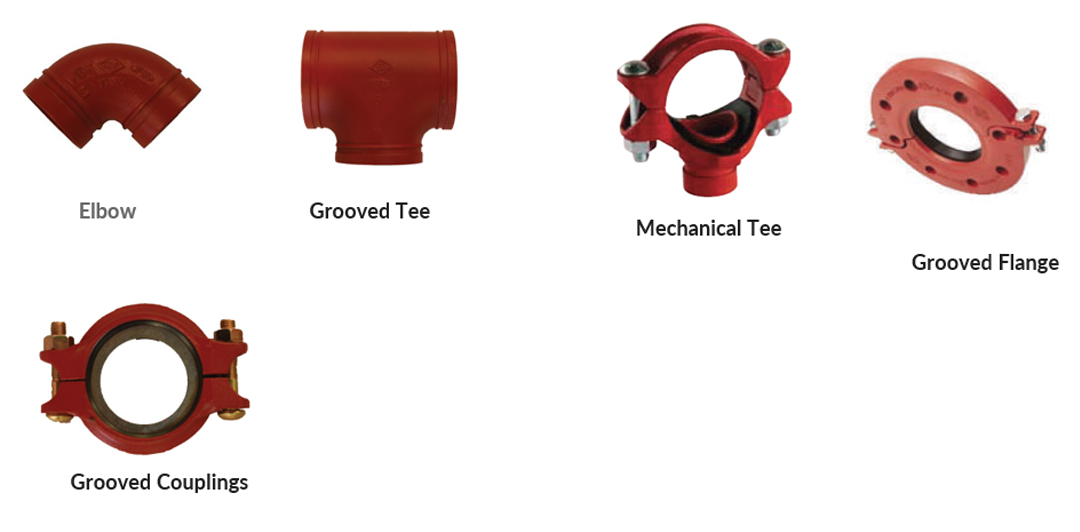
Grooved fittings join pipe using a coupling that clamps over grooves rolled or cut into the pipe ends. Matching fittings, valves and other components are made with the same groove profile, so every part of the system connects the same way.
The coupling holds a pressure-responsive gasket over the joint, and its shoulders engage the grooves on both sides. When the bolts are tightened, the coupling locks the two ends together and the gasket seals against the pipe. Because the joint needs no welding, threading or flanging, a grooved system is typically faster to install than the alternatives, and a section can be removed by undoing two bolts. Hotline Steel Trading supplies grooved pipe fittings from 25 mm to 300 mm as an alternative to welded, threaded, flanged or soldered joints.
How threaded fittings work
Threaded fittings have internal tapered threads that screw onto matching external threads cut on the pipe end. A thread sealant or tape is applied before assembly to make the joint watertight.
Threaded joints need only a pipe threader and wrenches, which makes them practical for small diameter lines and short runs. Cutting a thread removes part of the pipe wall, so threaded joints are normally kept to smaller sizes and moderate pressures. Hotline Steel Trading supplies threaded GI malleable iron fittings from 15 mm to 150 mm and MI fittings from ⅛″ to 2½″, designed to ASTM A197, ASTM A153 and ANSI/ASME B16.3, with threads to ANSI/ASME B1.20.1. For higher pressure duty there is also a range of threaded high pressure fittings.
Grooved vs threaded fittings compared
Grooved fittings suit larger lines and fast installation, while threaded fittings suit small bore pipework at low cost. The table compares them using the ranges Hotline Steel Trading supplies.
| Point | Grooved fittings | Threaded fittings |
|---|---|---|
| How the joint is made | Coupling and gasket over grooved ends | Fitting screwed onto threaded pipe |
| Sizes supplied | 25 mm to 300 mm | GI 15 mm to 150 mm, MI ⅛″ to 2½″ |
| Site preparation | Groove rolled or cut on pipe ends | Thread cut on pipe ends |
| Installation speed | Fast, especially on larger sizes | Practical on small sizes, slow on large sizes |
| Taking apart | Undo the coupling bolts | Unscrew, often needs a union |
| Hot work | None | None |
| Typical uses | Fire fighting mains, HVAC, large water lines | Plumbing, small branches, gas and air lines |
Grooved pipe fittings from 25 mm to 300 mm, supplied from Dubai.
When to choose grooved fittings
Grooved fittings are the better choice on larger diameter lines where installation time and future maintenance matter. They are widely used on fire fighting mains, chilled water and condenser water systems, and large water distribution lines in commercial and industrial buildings.
The main benefit is speed: a grooved joint goes together with two bolts, so a crew can install more pipe per day than with welded or threaded joints at the same size. No hot work is needed, which helps in occupied buildings and in areas where welding permits are difficult to obtain. Grooved valves and equipment connections also make it easy to remove a pump or valve later, and grooved valve ends are common on items such as triple duty valves in pump rooms.
When to choose threaded fittings
Threaded fittings are the better choice on small diameter pipework where the joint count is high and the pressure is moderate. Typical uses include plumbing, small water and air branches, sprinkler drops and equipment connections.
They need little equipment and the fittings themselves cost less, so they keep small bore work economical. Galvanized fittings pair with GI pipe on water lines, because welding would burn off the zinc coating at the joint. For a removable joint on a threaded line, a union is added next to the equipment.
What to include in a fittings enquiry
A fittings enquiry should state the joining method, sizes, fitting types and any approvals, so the supplier can quote the full list in one go.
- Joining method: grooved or threaded.
- Pipe sizes for each line, in mm or inches.
- Fitting types and quantities, for example elbows, tees, couplings, reducers and unions.
- Finish: galvanized, black or painted.
- Standards or approvals required by the project specification.
- Delivery location in the UAE.
Frequently asked questions
Are grooved fittings used in fire fighting systems?
Yes, grooved fittings and couplings are widely used in fire fighting pipework. The specific products must carry the listings or approvals required by the project and the local civil defence authority, so confirm these with the supplier before ordering.
Which standards do GI threaded fittings follow?
GI malleable iron fittings supplied by Hotline Steel Trading are designed to ASTM A197 for material, ASTM A153 for zinc coating, ANSI/ASME B16.3 for dimensions and ANSI/ASME B1.20.1 for pipe threads.
Can grooved and threaded fittings be used in the same system?
Yes. Many systems use threaded fittings on small branch lines and grooved fittings on larger mains, joined with suitable transition fittings or adapters.
Request a quote for pipe fittings
Send your fittings list with sizes and quantities and Hotline Steel Trading will reply with price and availability.


