
A concentric reducer and an eccentric reducer both join two pipes of different diameters, and the difference is where the smaller outlet sits. Hotline Steel Trading supplies MS concentric reducers and other butt weld fittings from Dubai to projects across the UAE, made to ASME B16.9 in sizes from ½″ to 24″. This guide explains how each reducer works, where each one is used and what to send us when you request a quote.
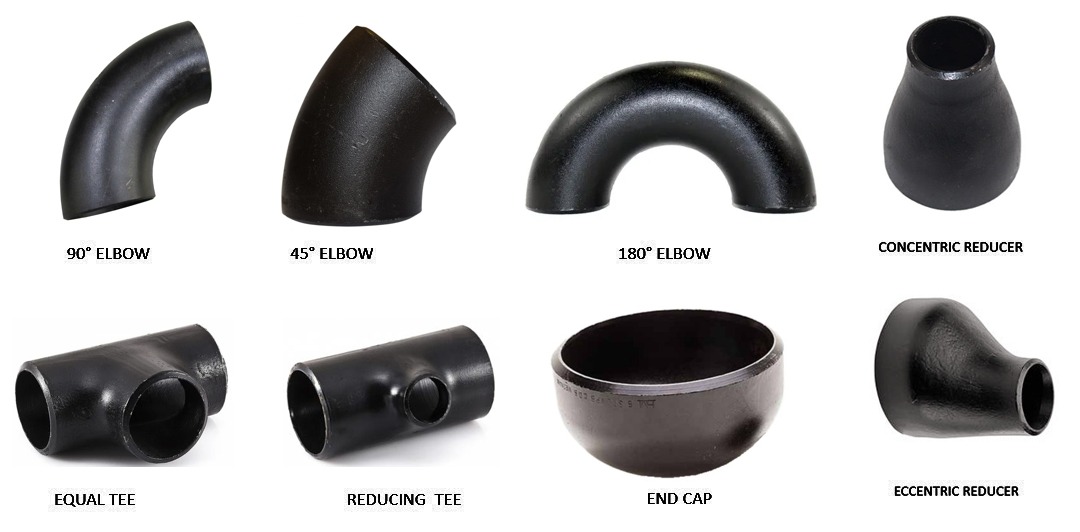
At a glance
- A concentric reducer keeps both ends on the same centre line.
- An eccentric reducer offsets the smaller end so one side of the pipe stays flat.
- Concentric reducers suit vertical lines and lines where trapped air is not a concern.
- Eccentric reducers are the normal choice on pump suction lines and pipe racks.
- Both are butt weld fittings dimensioned to ASME B16.9.
In this guide
What is a concentric reducer?
A concentric reducer is a cone-shaped butt weld fitting that joins a larger pipe to a smaller pipe with both ends on the same centre line. The taper is symmetrical, so the change in diameter is even all the way around the fitting and the pipe run continues in a straight line.
Because the centre line does not move, a concentric reducer keeps flow even as it speeds up through the smaller bore. That makes it the usual choice for vertical pipework, where any air simply rises through the fitting, and for gas and liquid lines where a small pocket of air or liquid at the top or bottom of the pipe is not a problem.
MS concentric reducers are made from carbon steel, typically to ASTM A234 WPB, with bevelled ends prepared for butt welding to ASME B16.25. Hotline Steel Trading supplies them in sizes from ½″ to 24″. You can see the full specification on our MS concentric reducer supplier page.
What is an eccentric reducer?
An eccentric reducer is a butt weld fitting that joins two pipe sizes with the smaller end offset from the centre line, so one side of the fitting is flat. The offset means either the top or the bottom of the pipe stays at the same level through the size change.
Installed flat on top, an eccentric reducer stops air or vapour collecting at the top of the line. This is why it is the standard fitting on the suction side of a pump. Installed flat on bottom, it keeps the underside of the pipe level, which helps liquid drain and keeps the pipe resting evenly on its supports in a pipe rack.
The flat side has to be fitted the right way round for the reducer to do its job, so the orientation is normally marked on the isometric drawing. Eccentric reducers are made to the same standards as concentric reducers and are part of the wider MS butt weld fittings range, alongside elbows, tees and caps.
Concentric vs eccentric reducer comparison
The main difference between the two reducers is the position of the smaller end, and that decides where each one is used. The table below sets out the practical differences.
| Feature | Concentric reducer | Eccentric reducer |
|---|---|---|
| Centre line | Both ends share one centre line | Smaller end offset, one side flat |
| Shape | Symmetrical cone | Asymmetrical, flat on one side |
| Air and liquid pockets | Can trap air on horizontal lines | Prevents pockets when fitted flat on top |
| Typical uses | Vertical lines, gas lines, pump discharge | Pump suction, pipe racks, drainage |
| Orientation on site | No orientation needed | Must be fitted flat on top or flat on bottom |
| Standard | ASME B16.9 | ASME B16.9 |
Which reducer to use on a pump suction line
An eccentric reducer installed flat on top is the correct fitting for a horizontal pump suction line. A concentric reducer in the same position leaves a high point at the top of the larger pipe where air or vapour can gather, and that pocket can be drawn into the pump.
Air entering a pump reduces its performance and can contribute to cavitation, which damages the impeller over time. Keeping the top of the suction line level removes the high point, so the flow reaching the pump stays full and steady.
On the discharge side the pressure is higher and air pockets are much less of a concern, so a concentric reducer is commonly used there. On vertical runs either type will work, and the concentric reducer is usually chosen because it keeps the line straight and is simpler to fit.
The discharge side of a pump also carries isolation, check and balancing valves, which are often combined in a single triple duty valve. These are part of the valve range from Hotline Steel Trading.
Need MS concentric reducers for a project in the UAE? We supply ½″ to 24″ to ASME B16.9.
Specifications to confirm before ordering
A reducer order needs both end sizes, both schedules, the material and the reducer type, so a supplier can confirm exactly what will be delivered. Sending these details together avoids a second round of questions and speeds up the quotation.
- Size reduction, written large end first, for example 6″ x 4″.
- Type: concentric or eccentric.
- Wall thickness or schedule at each end, matched to the connecting pipe.
- Material grade, for example carbon steel to ASTM A234 WPB.
- Dimensional standard, normally ASME B16.9 with ends to ASME B16.25.
- Quantity and delivery location in the UAE.
Reducers are usually ordered alongside ERW steel pipe or seamless pipe, matching pipe flanges and other butt weld fittings, and Hotline Steel Trading can quote the full list together.
Frequently asked questions
What does flat on top mean for an eccentric reducer?
Flat on top means the straight side of the eccentric reducer is installed uppermost, so the top of the pipe stays level through the size change. This orientation is used on pump suction lines so that air or vapour cannot collect at the reducer.
Can a concentric reducer be used on a horizontal line?
Yes, a concentric reducer can be used on a horizontal line where trapped air or liquid is not a concern, for example in many gas lines. Where air pockets or drainage matter, engineers normally specify an eccentric reducer instead.
Does a reducer need to match the pipe schedule?
Yes. The wall thickness at each end of the reducer should match the schedule of the pipe it is welded to, so give both end sizes and both schedules when you request a quote.
Request a quote for reducers
Send your sizes, schedules and quantities and Hotline Steel Trading will reply with price and availability.


